The $0 Productivity Hack: Why I Moved My Desk to Face a Blank Wall
It started as a joke. My partner walked into my home office one afternoon and said, “why is your desk facing a wall?” I had moved it on a whim after a particularly distracted week where I got almost nothing done. Three months later it is still facing the wall, and it is the single best productivity change I have ever made.
Direct Answer
Moving your desk to face a blank wall increases productivity by eliminating visual distractions and significantly reducing cognitive load. This setup creates a dedicated deep work environment by removing peripheral movement and clutter from your field of vision. It functions as a physical dopamine detox at work, allowing the brain to maintain a flow state and focus entirely on the primary task without external stimuli triggering task-switching.
What Happened to Me
For two years, I lived the Pinterest office dream. I had my desk positioned right in front of a large, beautiful window that overlooked the street. I thought the natural light and the view would spark my creativity. Instead, I spent my mornings watching the mail carrier, tracking the progress of a neighbor’s construction project, and getting mesmerized by the way shadows moved across the floor. I felt like a CEO in my command position, but my actual output was abysmal.
The breaking point came when I realized I was spending nearly twenty minutes an hour just staring into space, reacting to everything happening outside my window or inside my room. My brain was constantly processing peripheral data: the laundry pile in the corner, the dog walking past the door, the changing light. I was suffering from constant task-switching without even realizing it. One Tuesday afternoon, out of pure frustration, I unplugged everything and dragged my heavy oak desk to the most boring, windowless corner of the room. I turned it to face the plain, off-white wall. It was the best decision I ever made for my career.
At first, it felt claustrophobic. I felt like I was in “time out.” But within forty-eight hours, something shifted. The silence in my field of vision allowed my mind to go quiet. Without the visual noise, my screen became the only thing that existed. I stopped searching for distractions because there were none to find. This wasn’t just about a clean desk, it was about a clean perspective.
The Science of Visual Distraction and Deep Work
Our brains are wired to notice movement and change in our environment. This is an evolutionary survival trait, but in a modern deep work environment, it is a liability. Every time a car passes your window or a family member walks past your open door, your brain subconsciously processes that movement. This increases your cognitive load, which is the amount of mental effort being used in working memory.
When you face a blank wall, you are performing a physical dopamine detox at work. By removing the novelty bias (the urge to look at something new), you starve the brain of easy distractions. This forces the mind to seek stimulation from the work itself. Over time, this makes entering a flow state significantly easier because there are no competing visual signals fighting for your attention.
Facing the Wall vs. Facing the Room
Facing the Wall (The Monk)
- Primary Benefit: Maximum focus and deep work
- Distraction Level: Low to zero
- Cable Management: Easy (hidden against wall)
- Camera Background: Potential room exposure
- Space Efficiency: High (great for small rooms)
Facing the Room (The CEO)
- Primary Benefit: Collaborative and aesthetic
- Distraction Level: High (visual and auditory)
- Cable Management: Difficult (requires sleeves)
- Camera Background: Professional wall behind you
- Space Efficiency: Low (consumes floor space)
3 Crucial Office Focus Tips for a Wall-Facing Setup
The Blank Canvas Rule
Avoid covering the wall in front of you with Post-it notes, calendars, or busy artwork. If you must have something there, choose a single, low-contrast image or a simple shelf. The goal is to keep your peripheral vision clear of unnecessary information.
Lighting Strategy
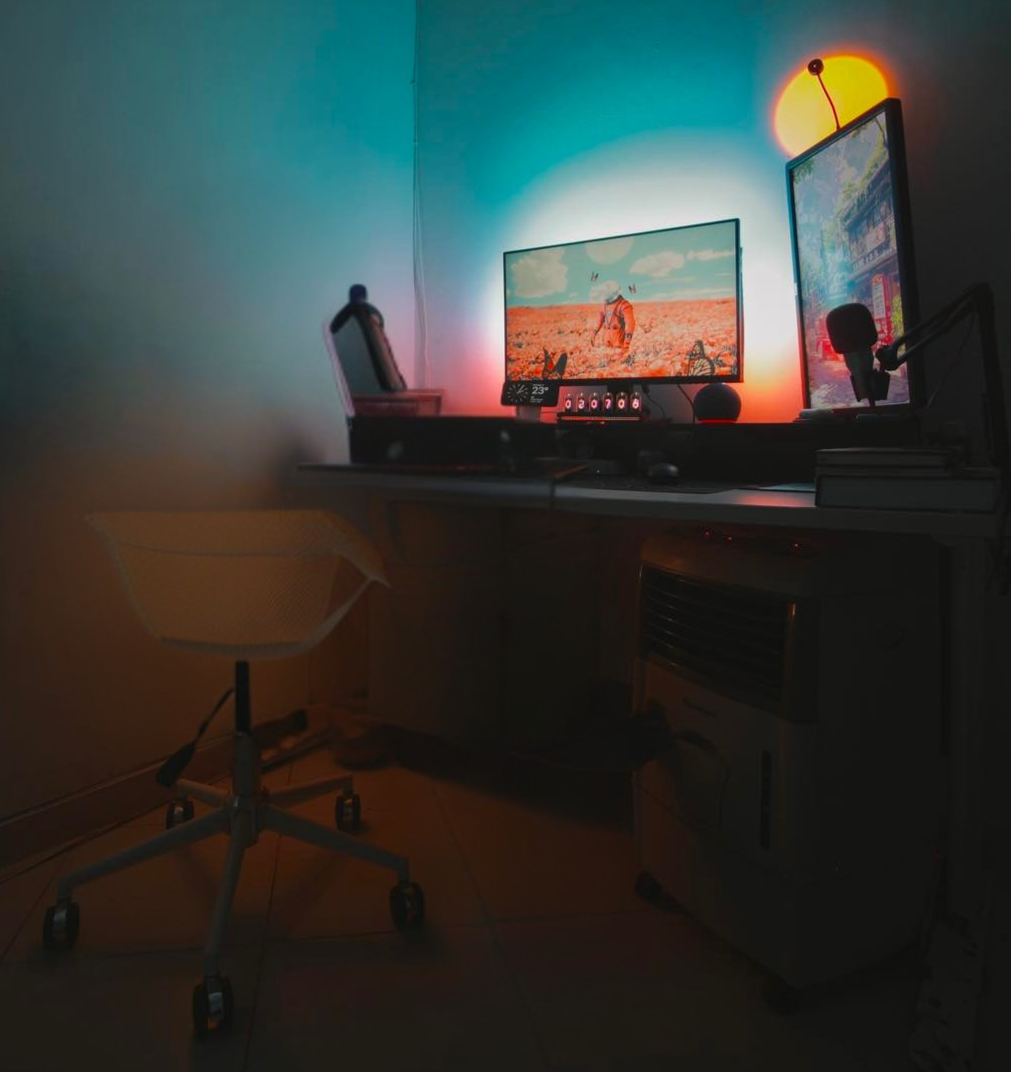
Facing a wall can lead to eye strain or screen glare. Using a monitor light bar or a small lamp pointed at the wall (bias lighting) reduces the harsh contrast between the bright screen and the darker wall, making it easier to work for long periods.
The 20-20-20 Rule
Since you no longer have a long-distance view, your eyes can get tired. Every 20 minutes, look at something 20 feet away for 20 seconds. This helps prevent visual fatigue in a closed-in setup.
Overcoming the Zoom Background Dilemma
One of the biggest complaints about facing the wall is the camera angle. When your desk is against the wall, your webcam usually points into the rest of your room. This can feel uncomfortable if your space isn’t tidy.
A simple solution is the “Side-Touch” layout. Instead of placing the desk flat against the wall, turn it so one end touches the wall while you sit with the wall to your side. This keeps your field of vision mostly distraction-free while allowing a more controlled camera angle. You can also use a portable room divider, blur your background, or apply a virtual background during calls.
Is a Messy Desk Really That Bad?
Many people justify a messy desk as a sign of creativity. However, research suggests that clutter can cost around 7.5 minutes of productivity per hour. When you face a wall, there’s a psychological advantage: even if the rest of your room is messy, you can’t see it. This effectively hides distractions from your brain and allows you to stay focused without the constant reminder of unfinished cleaning tasks.
Real Cost Breakdown
- Moving desk to wall: $0.00 (about 15 minutes of effort)
- Clearing wall decor: $0.00 (relocate distracting items)
- Cable management: $0.00 (use ties, tape, or existing materials)
- Lighting adjustment: $0.00 (reposition existing lamps)
Total Investment: $0.00
Result: Noticeable increase in daily output
FAQ
Does facing a wall make you more productive?
Yes. It minimizes visual stimuli that trigger task-switching, allowing your brain to focus more fully on your work.
What is the Thai Feng Shui principle for desks?
Traditional Feng Shui recommends the “Command Position,” where you face the door. However, for deep focus tasks, a “Focus Position” (facing a wall) is often more effective.
How do I manage cables if my desk is against the wall?
Run cables down the back legs of the desk using clips or ties. This keeps them hidden and reduces visual clutter.
Next Steps
If you struggle with focus, try the “Wall Test” for 48 hours. No new equipment is required, just move your desk to face a blank wall. The simplicity might feel uncomfortable at first, but that lack of stimulation could be exactly what your brain needs to concentrate and produce better work.
| Metric | Before (desk facing window) | After (desk facing wall) |
|---|---|---|
| Focused work hours per day | 2.5 h | 5 h |
| Phone check-ins per hour | 8 | 2 |
| Tasks completed per week | 11 | 19 |
| Interruptions (self-reported) | 14/day | 5/day |
| End-of-day energy (1-10) | 4 | 7 |